Mystery Tones in the Recorder
The Challenge
Blow harder into a recorder head and the pitch does not simply rise. It whistles, then drops to a lower note, and close to that drop a faint extra tone appears exactly one octave below the main pitch: the half-harmonic. It comes out of the coupling between a thin, unstable air jet, a sharp edge (the labium) and the resonating air behind it. A linear acoustic model can't explain it, and it is very hard to see inside a real instrument.
My Role & Collaborators
Visiting research student at MATINE Lab, KAIST, working with Jin Woo Lee on his GPU finite-difference flow–acoustic solver. I build the instrument geometry, run the jet-speed sweeps on the cluster, work on solver performance, and handle the signal analysis and visualisation of the flow and the sound.
Our Solution
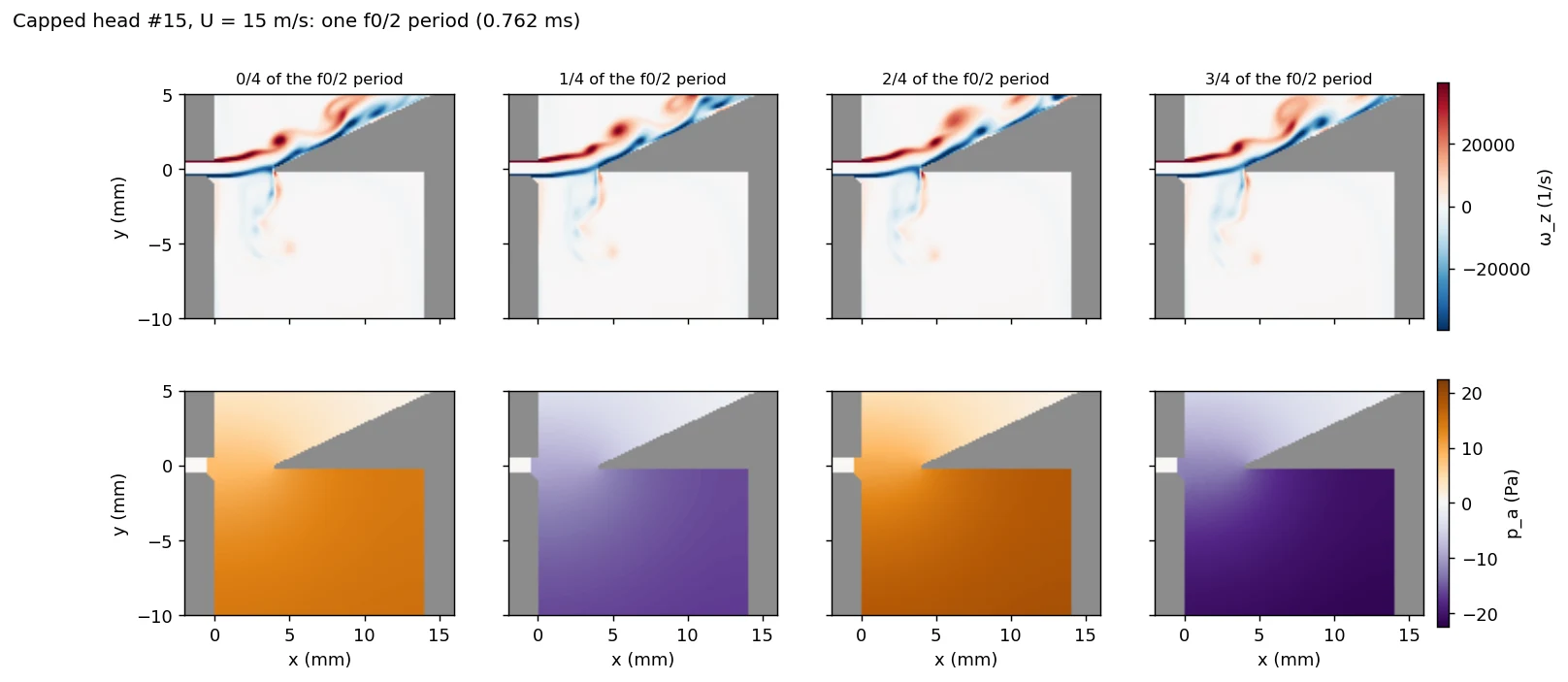
We rebuild the head in 3D and solve the incompressible flow and the sound field together with a hydrodynamic/acoustic splitting method. The jet and its vortices act as a Lighthill-type acoustic source, and the sound pushes back on the jet (two-way coupling). Virtual microphones in the mouth window, inside the cavity and in the far field record each blowing speed, so the simulation can be listened to as well as looked at. Filtering the flow field at the main pitch and at half of it shows where in the flow the mystery tone lives.
Key Techniques
- Incompressible Navier–Stokes with a hydrodynamic/acoustic splitting method
- Lighthill-type acoustic source terms with two-way flow–sound coupling
- GPU finite-difference solvers run on an HPC cluster
- 3D geometry of a capped recorder head with a sub-millimetre jet channel
- Virtual probes, spectral analysis and phase-band filtering of the flow (f₀ vs f₀/2)
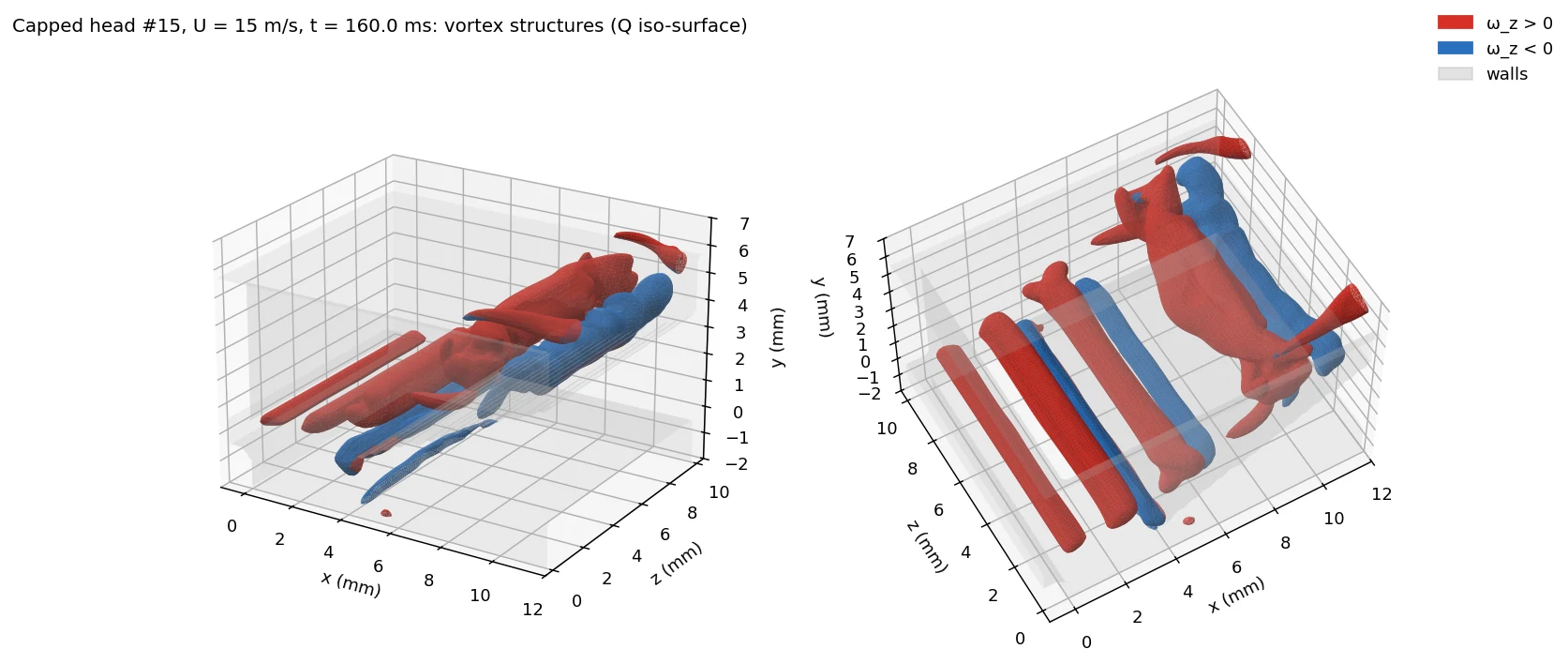
- Vortex identification with the Q-criterion, visualised in Python and ParaView
- the mystery tone
- f₀/2
- coupled flow + sound
- 3D
- FD solvers
- GPU
Results
Ongoing. The simulated blowing sweep reproduces the sequence heard in mechanical-mouth experiments: silence, a high whistle, the octave-below tone, then the drop to a lower note. More soon.
Project Gallery